

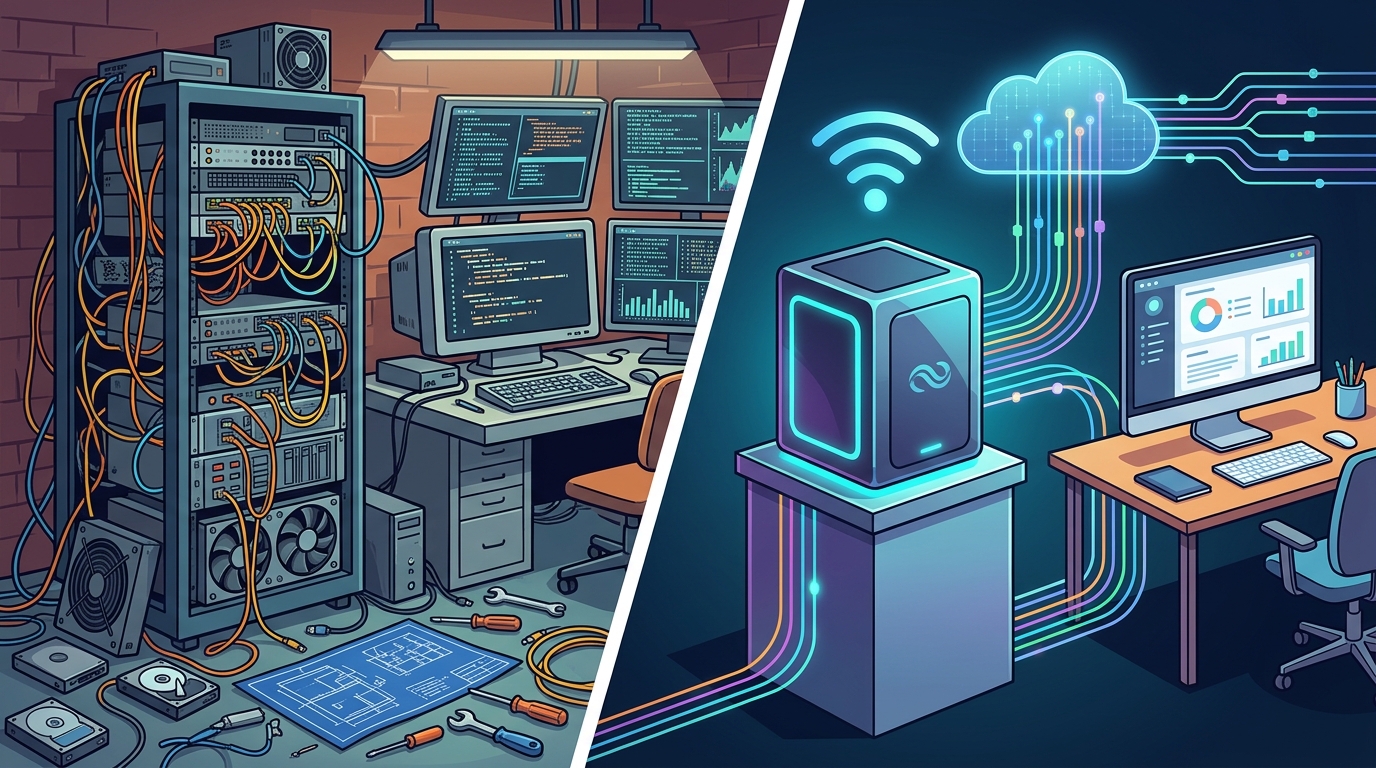
For small and midsize businesses, a managed company AI is a specialized service where a provider configures, operates, and maintains an AI system tailored to your specific workflows. This approach contrasts with hiring a full IT team or building a custom solution in-house, which requires significant capital, ongoing technical expertise, and dedicated management time. By outsourcing the operational burden, businesses can focus on core operations while leveraging AI capabilities without the overhead of traditional IT infrastructure.
The Cost and Complexity of Building In-House
Building a custom AI system in-house is often perceived as the most secure and controllable option, but it carries substantial hidden costs. A small business attempting to build its own AI must account for software development, data engineering, model training, and continuous maintenance. These tasks require specialized talent that is expensive and difficult to retain. For a team of ten or twenty, the cost of a dedicated data scientist or AI engineer often exceeds the budget of most small service businesses.
Furthermore, building in-house means owning the entire lifecycle of the technology. When models drift, data sources change, or new features are required, your internal team must handle the updates. This diverts valuable time from revenue-generating activities. In contrast, a managed service like Sabina handles the infrastructure and updates, allowing your team to focus on the business outcomes rather than the technical plumbing.
The Limitations of Traditional IT Teams
Many small businesses already have an IT manager or a small IT department. However, traditional IT roles are typically focused on infrastructure stability, such as network security, email management, and hardware support. They are rarely specialized in machine learning, prompt engineering, or AI integration. Hiring an IT team to manage AI requires a fundamental shift in skill sets and training.
Even if you hire an IT professional with AI skills, they are still a single point of failure. If that person leaves, the knowledge of how your AI system works may leave with them. A managed private AI service provides continuity. The provider, such as Dominus Foundry, operates the system and maintains the knowledge base, ensuring that the AI continues to function and improve regardless of internal staff turnover. This separation of duties allows your IT team to focus on core infrastructure while the AI provider handles the intelligent layer.
Authority and Control in Managed AI
A common concern with managed services is the loss of control. However, modern managed AI solutions are designed with granular authority controls. Written authority is a critical component of this model, where the business explicitly defines what the AI is permitted to do. This is not a black box where the AI acts autonomously without oversight. Instead, the business ratifies specific capabilities in writing, one at a time.
This approach ensures that the AI operates within strict boundaries. For example, the AI might be authorized to draft emails but not send them, or to log data but not delete it. This level of control is often harder to achieve with a generalist IT team, who may lack the specific governance frameworks for AI behavior. By defining authority explicitly, small businesses can mitigate risk while still benefiting from the efficiency of AI.
Operational Continuity and Data Privacy
Data privacy is a paramount concern for any business, especially when considering third-party services. A managed private AI service operates on independent primary operational databases for each company deployment. This means your data is not shared with other clients or used to train a general public model without your explicit consent. The Trust and privacy architecture ensures that your company’s information remains yours.
If you build in-house, you have full control over data, but you also bear the full burden of security compliance. If you hire a general IT team, they may not have the specialized security protocols for AI data. A managed service provider is responsible for the security of the AI infrastructure, including encryption, access controls, and retention policies. This shared responsibility model allows small businesses to achieve enterprise-grade security without the enterprise-grade cost.
Choosing the Right Path for Your Business
The decision between managed AI, in-house IT, and custom development depends on your specific needs, budget, and technical maturity. For most small and midsize businesses, the managed approach offers the best balance of cost, control, and capability. It provides the intelligence of a custom system with the ease of a service. You do not need to become an AI company to benefit from AI.
Before making a decision, it is helpful to assess your current readiness. The assessment tool can help you understand where your firm stands and what you might gain from a private AI. This evaluation looks at your current workflows and identifies areas where AI could provide immediate value. By starting with a clear assessment, you can make an informed decision that aligns with your business goals.
Key Takeaways
- Building AI in-house requires specialized talent and significant capital, which is often prohibitive for small businesses.
- Traditional IT teams focus on infrastructure and may lack the specific skills needed to manage and maintain AI systems.
- Managed AI services provide operational continuity and reduce the risk of knowledge loss due to staff turnover.
- Granular authority controls allow businesses to define exactly what the AI can and cannot do, ensuring safety and compliance.
- Private AI deployments use independent databases to protect data privacy, ensuring your information is not shared with other clients.
- A managed service shifts the burden of maintenance and updates to the provider, allowing your team to focus on core business activities.
Frequently Asked Questions
Is a managed AI service more expensive than hiring an IT person?
For most small businesses, a managed AI service is more cost-effective than hiring a full-time AI specialist. The cost of a managed service is predictable and includes maintenance, updates, and support. Hiring an AI engineer typically costs significantly more and does not include the infrastructure or model training costs.
Do I lose control of my data with a managed service?
No. Managed private AI services use independent databases for each client. Your data is held for your company alone and is yours. You define the permissions and authority the AI has, ensuring that you maintain control over how your information is used.
Can I switch from a managed service to in-house later?
Yes, but it requires a significant transition. If you leave a managed service, the data is turned over to you. However, the model and software are the provider’s property. You would need to build or purchase a new system to continue using AI in-house.
What kind of businesses benefit most from managed AI?
Small and midsize businesses in service industries, such as property management, insurance, law, and accounting, benefit most. These businesses have complex workflows and customer interactions that can be streamlined with AI, but they often lack the technical resources to build it themselves.
How is authority defined in a managed AI system?
Authority is defined through written grants. The business specifies which capabilities the AI has and what actions require approval. This ensures that the AI operates within strict boundaries and that every action is recorded and auditable.
Does the AI learn from my business data?
The AI learns from the sources and instructions you provide. This learning is recorded in a separate system from the authority system. What the AI learns about your business does not automatically grant it new permissions. You decide when its responsibilities or authority change. Learn more: Questions Sabina.