

Small accounting firms face a constant pressure to balance high-volume tax preparation with the need for personalized client advice. Manual data entry and repetitive document sorting consume hours that could be spent on higher-value consulting. The right automation stack reduces this friction by handling the mechanical parts of the workflow, allowing your team to focus on judgment and strategy.
1. Intelligent Document Processing (IDP)
Automate the intake of messy financial documents to eliminate manual data entry.
Intelligent Document Processing is a technology that uses machine learning to read, classify, and extract data from unstructured documents like invoices, receipts, and bank statements. For small firms, this is the first line of defense against backlogs. Instead of a staff member typing figures from a PDF into a spreadsheet, the software recognizes the document type and pulls the relevant fields directly into your system.
2. Automated Data Extraction
Ensure accuracy by pulling specific data points directly into tax preparation software.
Automated data extraction is the process of converting unstructured data into structured, usable formats. While IDP identifies the document, extraction tools map specific fields, such as vendor names or tax categories, to the correct lines in your tax software. This reduces human error and ensures that the data entering your preparation platform is clean and consistent.
3. AI-Powered Drafting Assistants
Speed up the creation of client communications and tax summaries using generative AI.
AI drafting tools are software applications that generate written content based on prompts and existing data. In a tax context, these tools can help draft initial client emails, summarize complex tax changes, or create first-pass explanations for tax positions. This allows your team to review and refine the language rather than starting from a blank page, significantly reducing the time spent on routine correspondence.
4. Client Communication Portals
Reduce email clutter by centralizing document requests and status updates.
A client communication portal is a secure web interface that allows clients to upload documents and view the status of their tax preparation. This tool automates the back-and-forth of chasing missing information. When a client logs in, they see exactly what is needed, and the system can send automated reminders. This keeps the workflow moving without requiring your staff to send individual follow-up emails.
5. Workflow Automation Engines
Connect your tools so that data moves automatically between stages of the tax cycle.
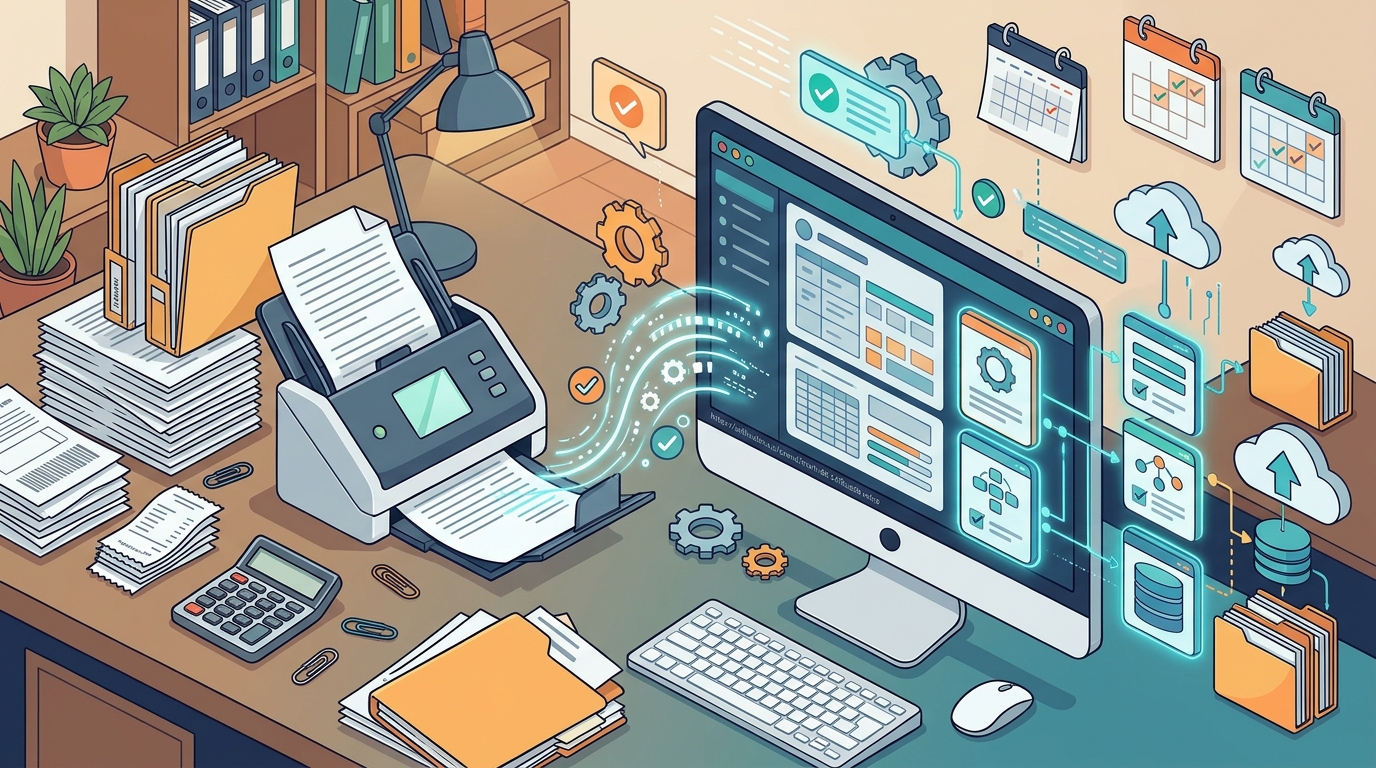
Workflow automation is the use of software to move data and tasks between applications without manual intervention. For example, once a document is processed by an IDP tool, a workflow engine can automatically assign the task to the appropriate preparer and update the client portal. This ensures that no step is missed and that the team always knows what to work on next.
6. Integrated Practice Management
Unify billing, task management, and tax preparation in a single platform.
Integrated practice management is a software suite that combines client management, billing, and tax preparation tools. For small firms, using a single platform reduces the need to switch between multiple applications. When your practice management system is integrated with your tax software, data flows seamlessly, and you can track the profitability of each client engagement in real time.
7. Managed Private Business AI
Deploy a dedicated AI assistant that understands your firm's specific processes and client history.
Managed private business AI is a service where a provider builds and operates a custom AI assistant for your company, using your own data and models. Unlike generic tools, a managed AI like Sabina is configured to understand your firm's unique workflows, client preferences, and internal terminology. It can handle follow-through on tasks, draft responses based on your firm's voice, and maintain a record of decisions. This level of customization ensures that the AI acts as a true extension of your team, not just a generic chatbot.
Choosing the Right Tool for Your Firm
Selecting the right automation tool depends on your firm's current pain points and budget. If your main issue is data entry, start with IDP and extraction tools. If your team is overwhelmed by communication, prioritize a client portal and drafting assistants. For firms looking for a comprehensive solution that integrates with their existing systems and provides a dedicated AI assistant, consider a managed private AI service. The goal is to automate the mechanical tasks so your team can focus on the advisory work that drives client retention.
Frequently Asked Questions
What is the most common time-waster in tax preparation?
Manual data entry and document sorting are the most common time-wasters. These tasks are repetitive and prone to error, making them ideal candidates for automation through IDP and extraction tools.
Can AI replace a tax preparer?
No, AI cannot replace the judgment and accountability of a human tax preparer. AI tools are designed to assist with data processing and drafting, but final review and sign-off must remain with a qualified professional.
How does a managed private AI differ from a generic chatbot?
A managed private AI is built specifically for your company, using your own data and models, and is operated by a provider. A generic chatbot is a public tool that does not have access to your firm's private information or specific workflows.
Is it safe to use AI for client data?
Yes, provided you use tools that prioritize privacy and security. Managed private AI services, such as Sabina, use independent databases and strict authority controls to ensure that your client data is not shared or used to train models for other companies.
How long does it take to implement tax automation?
Implementation time varies by tool. Simple tools like client portals can be set up in days, while more complex systems like managed private AI may take a few weeks to configure and integrate with your existing workflows.
What is the cost of automated tax preparation software?
Costs vary widely depending on the features and the size of your firm. Generic tools may have a per-user subscription fee, while managed private AI services often have a custom pricing model based on the scope of work and the number of users.