

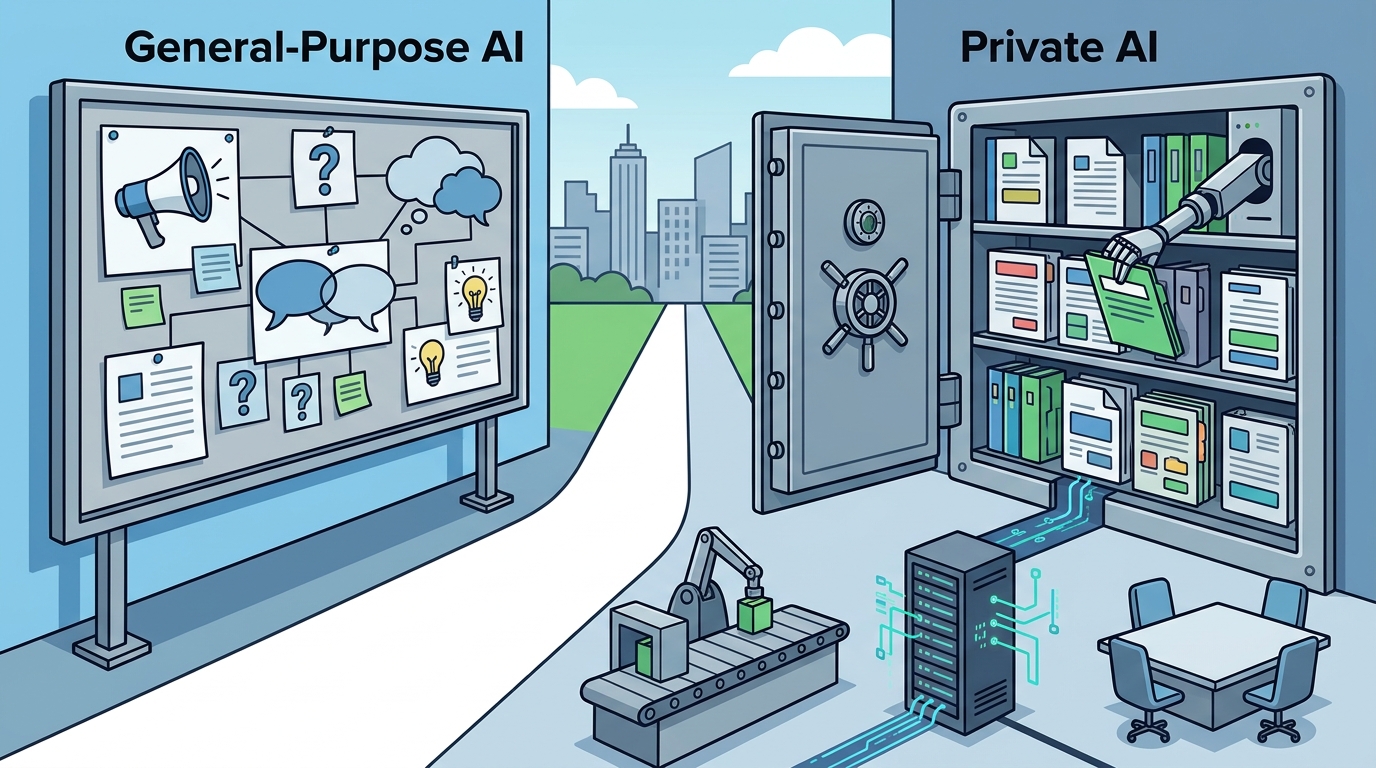
Private AI platforms are built to operate within a specific company's context, whereas general-purpose tools rely on broad, shared knowledge. For growing businesses, this distinction determines whether AI can handle sensitive operational tasks or only provide generic advice. Sabina, a managed private business AI, addresses this gap by integrating directly with your company's records and workflows.
The Context Gap in General-Purpose AI
General-purpose AI tools are trained on vast public datasets. They excel at creative writing, coding, and broad analysis. However, they lack specific knowledge of your internal processes, customer history, or proprietary data. This creates a context gap where the AI must guess or rely on user-provided prompts for every interaction.
For a small business, this means employees must constantly re-explain their company's unique rules and history to the AI. The tool remains a generic assistant rather than a specialized team member. Without persistent, company-specific memory, the AI cannot learn from past interactions to improve future performance.
Sabina addresses this by starting with your company's context. It is shaped around your specific industry and operational needs. This allows the AI to understand the nuances of your business without requiring constant re-education from your staff.
Authority and Control in Private AI
Authority is the defined scope of actions an AI is permitted to take. In general-purpose tools, users often have limited control over what the AI can do with sensitive data. In private AI platforms, authority is explicitly managed by the business owner.
Sabina uses a written authority model where you decide what the AI may do, what needs your approval, and what stays with your team. This separation ensures that learning does not automatically grant permission to act. For example, the AI might learn that a customer prefers a specific discount, but it cannot apply that discount unless you have explicitly authorized that capability.
This level of control is critical for growing businesses that handle sensitive client information. It provides a clear audit trail and ensures that AI actions align with your business policies and legal requirements.
Data Privacy and Ownership
Data privacy is the protection of sensitive information from unauthorized access or use. General-purpose AI tools often use user data to improve their shared models, which can raise concerns for businesses with confidential client data. Private AI platforms prioritize data isolation and ownership.
Sabina operates on independent primary operational databases for each company deployment. Your company's data is held for your company alone and remains yours. If you decide to leave the service, your data is turned over to you. This approach ensures that your business intelligence is not shared with competitors or used to train models that benefit other users.
For industries like law, accounting, or property management, this data isolation is a fundamental requirement. It allows businesses to leverage AI for efficiency without compromising client confidentiality or regulatory compliance.
Operational Integration and Follow-Through
Operational integration is the ability of an AI to connect with existing business systems and workflows. General-purpose tools often operate in silos, requiring manual data entry and output copying. Private AI platforms are designed to integrate with your specific operational tools.
Sabina includes Forge, a structured workspace for agreed business records. It helps keep responsibilities, owners, and next steps connected. For instance, if a customer calls to change a job requirement, Sabina can capture that change and ensure the relevant team member is notified. This follow-through reduces the administrative burden on your team and ensures that promises made to customers are kept.
This integration transforms AI from a passive chatbot into an active participant in your daily operations. It handles the coordination and follow-up tasks that often fall through the cracks in growing businesses.
Choosing the Right AI for Your Growth Stage
Choosing the right AI depends on your specific business needs and growth stage. General-purpose tools are suitable for occasional drafting, brainstorming, or analysis where company-specific context is not critical. Private AI platforms are better suited for ongoing operational responsibilities where context, authority, and data privacy are paramount.
As your business grows, the complexity of your operations increases. The need for AI that understands your specific context and can act within defined boundaries becomes more important. Sabina is designed for small and midsize businesses that need a reliable AI partner to manage their operations and customer interactions.
By evaluating your specific tasks and data requirements, you can determine whether a general-purpose tool or a private AI platform like Sabina is the better fit for your business goals.
Key Takeaways
- Private AI platforms operate within a specific company's context, unlike general-purpose tools that rely on shared public data.
- Authority in private AI is explicitly managed, ensuring that AI actions align with business policies and legal requirements.
- Data privacy is prioritized in private AI through independent databases and clear ownership terms.
- Operational integration allows private AI to connect with existing systems and handle follow-through tasks.
- General-purpose tools are best for occasional, non-sensitive tasks, while private AI is suited for ongoing operational responsibilities.
- Sabina provides a managed private AI solution with Forge included, offering structured workspace and authority control.
- Choosing the right AI depends on your business's specific needs for context, control, and data privacy.
Frequently Asked Questions
What is the main difference between private AI and general-purpose AI?
Private AI is built to operate within a specific company's context and data, while general-purpose AI relies on broad, shared public knowledge. Private AI offers more control over authority and data privacy.
How does Sabina handle data privacy?
Sabina uses independent primary operational databases for each company deployment. Your data is held for your company alone and remains yours, ensuring it is not shared with other users or used to train shared models.
Can I control what Sabina is allowed to do?
Yes, Sabina uses a written authority model where you decide what the AI may do, what needs your approval, and what stays with your team. This ensures that learning does not automatically grant permission to act.
Is Sabina suitable for all types of businesses?
Sabina is designed for small and midsize businesses, including property managers, insurance agencies, law firms, and accounting/tax firms. It is best suited for businesses that need company-specific context and controlled AI actions.
What is Forge in the context of Sabina?
Forge is the included workspace for agreed business records. It helps keep responsibilities, owners, and next steps connected, providing a structured environment for the AI to operate within your business context.
How does Sabina differ from a virtual assistant?
Sabina is company AI, not a human assistant. It is designed to handle specific operational tasks within defined authority boundaries, whereas a virtual assistant uses human judgment within an agreed role. Sabina provides a consistent, scalable AI solution.
Next Steps for Your Business
If you are considering AI for your growing business, start by identifying the specific tasks that would benefit from company-specific context and controlled authority. Evaluate whether a general-purpose tool meets your needs or if a private AI platform like Sabina is a better fit. To explore how Sabina could help your company, you can start your assessment or see how getting started works.