

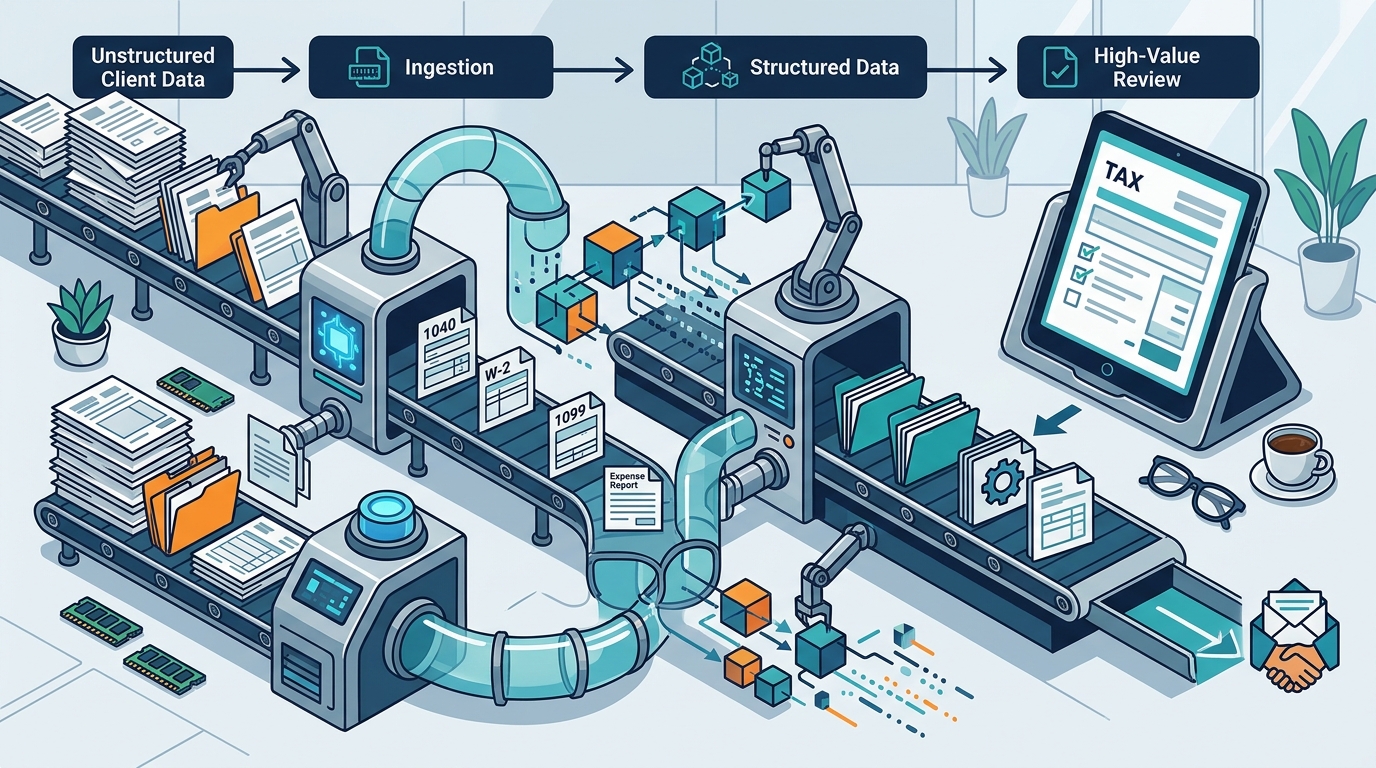
AI streamlines tax preparation by automating data extraction, document classification, and initial draft generation. For accounting firms, this shifts the focus from manual data entry to high-value review and client communication. Sabina, a managed private business AI built by Dominus Foundry, helps firms connect these operational steps. It ensures that client data, deadlines, and follow-ups are handled with the context and authority your team defines.
Automating Data Ingestion and Classification
The first bottleneck in tax preparation is often the collection and organization of client documents. Traditional methods rely on manual sorting of PDFs, emails, and spreadsheets. AI systems can now ingest these files and classify them by tax category, such as income, deductions, or credits. This reduces the time accountants spend on administrative sorting. By using a structured workspace, firms can ensure that every document is tagged correctly before the drafting phase begins.
Sabina integrates with your existing systems to manage this flow. It uses a structured workspace called Forge to store and organize business records. This means that when a client sends a new document, the system can identify its relevance and place it in the correct context. The implication is a cleaner start to the preparation process, where the data is already organized for review.
Accelerating Draft Preparation and Review
Once data is organized, AI can generate initial drafts of tax returns. This is not about replacing the accountant, but about providing a starting point. The AI analyzes the classified data and applies standard tax rules to create a preliminary return. The accountant then reviews this draft, correcting any errors and adding professional judgment. This workflow significantly reduces the time spent on initial drafting.
In this model, the AI acts as a preparer, while the human acts as the reviewer. Sabina supports this by preparing useful drafts and briefings from available information. The firm retains control over what is finalized. This approach allows firms to handle higher volumes of returns without increasing headcount. It also ensures that the final product still carries the professional liability and judgment of the licensed accountant.
Managing Client Communication and Follow-ups
Tax preparation is not just about numbers; it is about communication. Clients often have questions about their returns, missing documents, or deadlines. Managing these inquiries can distract accountants from their core work. AI can handle routine client communications, answering standard questions and requesting missing information. This keeps the client informed and reduces the administrative burden on the team.
Sabina is designed to handle these interactions with company-specific context. It can answer questions based on the client's records and the firm's policies. For example, if a client asks about a specific deduction, the AI can reference the supporting documents in Forge. This ensures that the response is accurate and consistent. The implication is a more responsive client experience, which can improve retention and satisfaction.
Ensuring Compliance and Authority Controls
As AI takes on more tasks, firms must ensure that it operates within strict boundaries. Compliance is a top priority in accounting. AI systems must be configured to follow specific rules and only take actions that are authorized. This requires a clear definition of what the AI can and cannot do. Without these controls, there is a risk of errors or unauthorized actions.
Sabina operates on a model of written authority. The firm decides what Sabina may do, what needs approval, and what stays with the team. This ensures that the AI does not act on its own for sensitive tasks. The system records every action, providing an audit trail. This level of control is essential for maintaining trust and meeting regulatory requirements. It allows firms to adopt AI without compromising their professional standards.
Implementing AI in Your Firm
Implementing AI in an accounting firm requires a strategic approach. Start with one useful task, such as data ingestion or draft preparation. Assess the fit with your current workflows and systems. Sabina offers a guided assessment to help firms identify where AI can add value. This process involves defining the responsibilities and permissions for the AI. It ensures that the implementation is tailored to the firm's specific needs.
The goal is to create a workflow that is efficient and secure. By starting small and expanding gradually, firms can manage the transition effectively. Sabina is set up and managed for you, so you do not need to build the infrastructure yourself. This allows your team to focus on the work that requires human judgment. The result is a more streamlined operation that can scale with your firm's growth.
Key Takeaways
- AI automates data ingestion and classification, reducing manual sorting time.
- Draft generation provides a starting point for accountants to review and finalize.
- AI handles routine client communication, improving responsiveness and reducing administrative load.
- Written authority controls ensure AI operates within compliance boundaries.
- Structured workspaces like Forge organize business records for efficient access.
- Implementation should start with one useful task and expand gradually.
- Managed AI services like Sabina handle setup and operation, allowing firms to focus on core work.
Frequently Asked Questions
What is managed private business AI?
Managed private business AI is a service where a provider sets up and operates an AI system for a specific company. The AI is trained on the company's data and operates under defined permissions. It is private, meaning the data is not shared with other companies.
How does Sabina handle client data?
Sabina uses independent primary operational databases for each company deployment. This ensures that your data is kept separate and secure. You decide which sources the AI can access and what it can do with that data.
Can AI replace accountants in tax preparation?
No, AI is a tool to assist accountants. It handles routine tasks like data entry and draft generation, but human judgment is still required for review and finalization. The accountant remains responsible for the accuracy and compliance of the return.
What is Forge in the context of Sabina?
Forge is a structured workspace included with Sabina. It is used to store and organize business records and work. It provides a central place for the AI to access information and for the team to review its work.
How do I get started with Sabina?
You can start by taking the assessment on the Sabina website. This helps identify where AI could help your company. After the assessment, you can meet with a representative to discuss the product and receive a written proposal.
Is Sabina suitable for small accounting firms?
Yes, Sabina is built for small and midsize businesses, including accounting and tax firms. It is designed to be set up and managed for you, so you do not need a large IT team to implement it.
Next Steps for Your Firm
Streamlining tax preparation with AI is a practical step for accounting firms looking to improve efficiency. By automating routine tasks and managing client communication, you can free up your team to focus on high-value work. Sabina provides a managed solution that handles the setup and operation of this AI. To see how Sabina could help your firm, start your assessment today.