

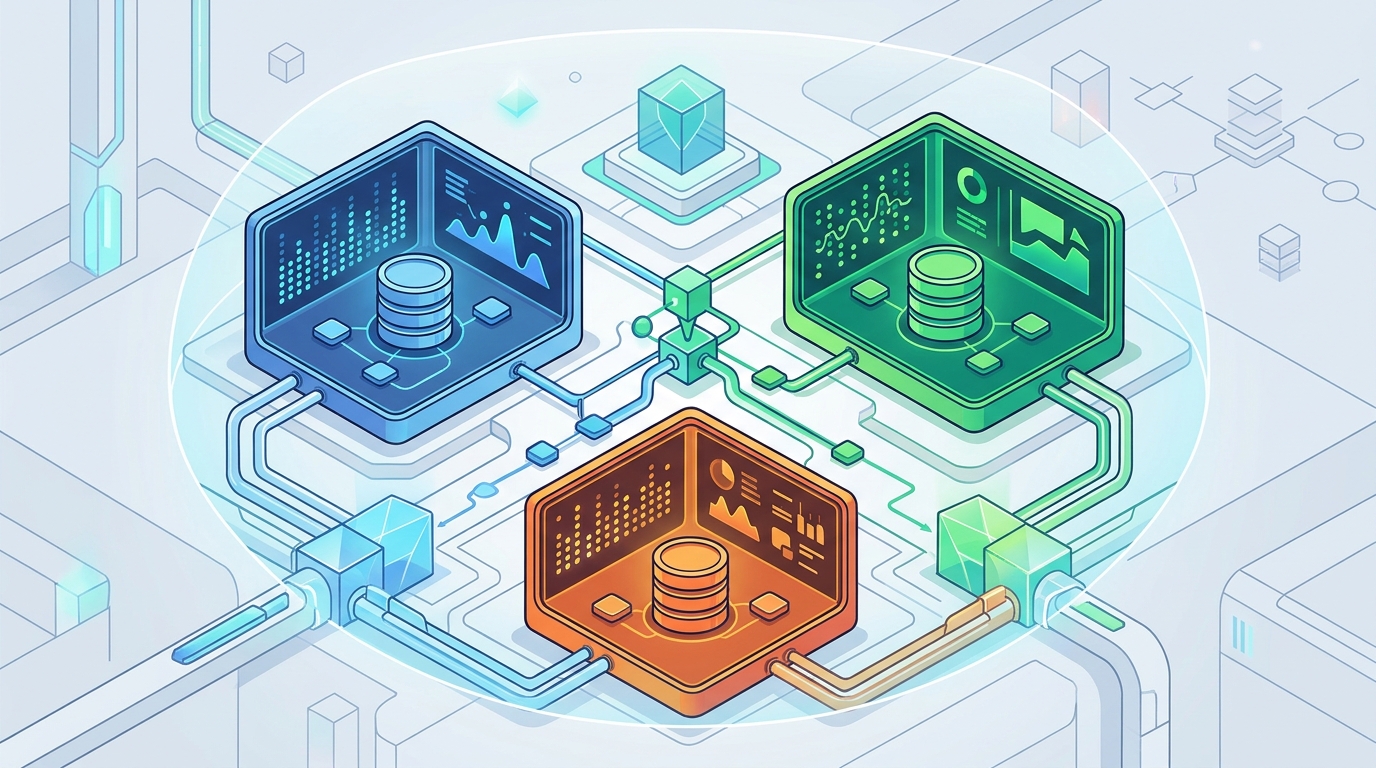
Data isolation in private AI systems is the architectural practice of ensuring that one client's proprietary information, training data, and operational records remain strictly separated from other clients and from the underlying model weights. For small and midsize businesses, this separation is not merely a privacy preference; it is a structural requirement that prevents cross-contamination of sensitive business logic. Sabina by Dominus Foundry implements this through independent primary operational databases for each deployment, ensuring that your company's data is held for your company alone.
The Distinction Between Model Weights and Client Data
A common misconception in enterprise AI is that data isolation means the model itself is rebuilt for every client. In reality, model weights are the learned parameters of the AI, while client data is the specific information the AI processes. True isolation requires that client data never permanently alters the shared model weights in a way that exposes it to other users. Dominus Foundry operates Sabina's reasoning on its own models, but the specific company context is stored in a separate, proprietary memory system. This means the AI can understand your business without your data becoming part of the public model's training set.
The implication for business owners is clear: you are not renting a generic AI that has seen your competitors' data. You are using a managed service where the foundational intelligence is shared, but the specific knowledge and records are yours. This architecture allows for high-performance reasoning without the security risks associated with multi-tenant shared memory pools.
Independent Operational Databases
This separation extends to how the AI retrieves information. When Sabina answers a question, it queries your specific database, not a shared global index. This prevents the AI from accidentally referencing a similar case from another client. For a law firm or an accounting practice, this level of separation is critical to maintaining client confidentiality and professional liability standards.
Separation of Learning and Authority
Data isolation is not just about storage; it is about control. A critical component of private AI architecture is the separation of learning systems from authority systems. In many AI implementations, if the AI learns a new fact, it might automatically gain the ability to act on that fact. This is a significant security risk. Sabina keeps these systems separate by design. What the AI learns about your business sits in a distinct system from the one that governs what it is authorized to do.
This means that even if the AI infers a sensitive pattern from your data, it does not automatically gain permission to execute an action based on that inference. Authority is a separately ratified written object. This architectural choice ensures that data isolation is maintained not just in storage, but in the decision-making process. The AI can know, but it cannot act without explicit, written authorization from your team.
Data Ownership and Exit Strategies
True data isolation must include a clear path for data ownership and exit. Many AI services retain client data indefinitely or make it difficult to retrieve. In a properly isolated system, the client retains full ownership of their data. If you leave the service, your data is turned over to you. Dominus Foundry does not hold your data hostage. The form and timetable of the handover are set out in writing when you start the service.
Practical Implications for Business Operations
Understanding data isolation helps business leaders make informed decisions about AI adoption. The primary implication is that you can use advanced AI capabilities without compromising your competitive advantage. Your business logic, customer relationships, and operational workflows remain private. This allows you to leverage AI for efficiency and insight while maintaining the trust of your clients and partners.
For example, a property management company can use Sabina to handle tenant inquiries and maintenance requests. The AI learns the specific nuances of their portfolio, but that knowledge is isolated to their deployment. Other property management companies using the same AI platform do not have access to this specific data. This isolation enables the AI to provide highly relevant, context-aware responses without risking data leakage.
Key Takeaways
- Model weights and client data are separate: The AI's foundational intelligence is shared, but your specific data is stored in a proprietary memory system.
- Independent databases are critical: Each client deployment uses its own primary operational database to prevent cross-contamination.
- Learning and authority are decoupled: The AI's knowledge does not automatically grant it permission to act; authority is a separate, ratified system.
- Data ownership is retained by the client: You own your data, and it is returned to you if you leave the service.
- Isolation supports compliance: Proper data isolation helps meet professional and regulatory confidentiality standards.
- Managed services simplify isolation: Providers like Dominus Foundry handle the complex infrastructure, allowing you to focus on business operations.
Frequently Asked Questions
Does data isolation mean the AI is built from scratch for each client?
No. Data isolation means that your specific data is stored and processed separately from other clients. The underlying AI model may be shared, but your data does not become part of the shared model's training set.
How does Sabina ensure that my data is not used to train the model for other clients?
Sabina uses independent primary operational databases for each deployment. Your data is held for your company alone and is not used to train the core model for other users. The proprietary memory system is specific to your company.
What happens to my data if I stop using the service?
Your data is yours. If you leave, it is turned over to you. The form and timetable of the handover are set out in writing when you start the service. Dominus Foundry does not hold your data hostage.
Can the AI learn from my data and then act on that learning without my permission?
No. Learning and authority are separate systems. What the AI learns about your business does not automatically give it permission to act. Authority is a separately ratified written object that defines what the AI may do.
Is data isolation the same as data encryption?
Encryption is a security measure that protects data in transit and at rest. Data isolation is an architectural practice that ensures logical and physical separation of client data. Both are important, but they serve different purposes.
How does this architecture benefit small and midsize businesses?
It allows small and midsize businesses to use advanced AI capabilities without the security risks associated with large, shared multi-tenant systems. It ensures that your competitive advantage and client confidentiality are protected.
Conclusion
Data isolation is the foundation of trust in private AI systems. By separating model weights from client data, using independent databases, and decoupling learning from authority, providers like Sabina by Dominus Foundry ensure that your business remains private and secure. This architecture allows you to leverage the power of AI without compromising your competitive advantage or client confidentiality. To explore how this architecture works in practice, you can find where Sabina could help your company.