

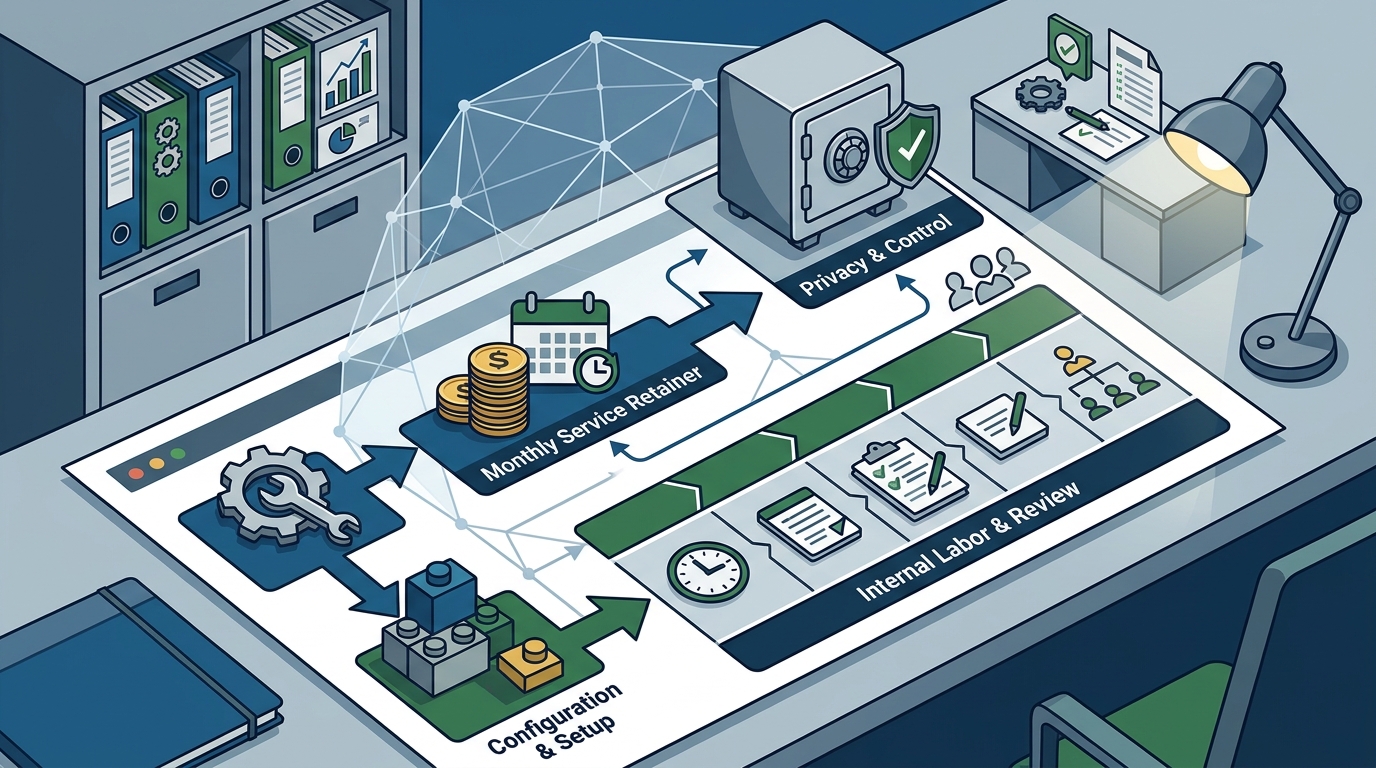
When budgeting for a managed AI service, you must account for the monthly subscription, potential setup fees, and the internal labor required to train and review the system. For small and midsize businesses, the primary cost is often the service retainer, which covers configuration and ongoing operation. You should also reserve time for your team to define authority and review outputs. This ensures the AI operates within your specific business rules and privacy boundaries.
Understanding the Core Service Retainer
The most direct cost of bringing a managed AI into your organization is the monthly service fee. This fee typically covers the provider's responsibility to configure, operate, and maintain the AI system. It is distinct from a simple software license because it includes human oversight and technical management. For example, Sabina offers a standard managed AI service for $1,500 per month. This price includes the Forge workspace, which serves as the structured memory for your business records. There is no setup fee for the standard offer, which simplifies initial budgeting. Larger accounts may receive custom pricing, so you should request a written proposal to confirm the exact scope.
Internal Labor and Training Costs
While the provider handles the technical infrastructure, your team must invest time in teaching the AI your business context. This internal labor is a hidden cost that many organizations overlook. You need to assign a point person to define what the AI is authorized to do and to review its outputs. This process is not a one-time task; it is an ongoing responsibility. For instance, if you have a team of ten people, each spending an hour a day on administrative follow-through, the AI can help reduce that burden. However, you must still allocate time for initial setup and periodic reviews. This ensures the AI remains accurate and aligned with your evolving business needs.
Integration and Data Preparation
Integrating a managed AI with your existing systems requires careful planning and potential costs. You need to ensure that the AI has access to the necessary data sources, such as your CRM, email, or project management tools. This may involve API access or manual data entry. The provider will typically verify these connections during the setup phase. For example, if you keep your records in a third-party system, the provider must verify API access and the reads, writes, and updates needed for the work. This step is crucial for ensuring the AI can perform its designated tasks without errors. You should budget for any necessary data cleaning or migration before the AI goes live.
Authority and Governance Frameworks
Establishing a clear authority framework is essential for safe and effective AI deployment. This involves defining what the AI can do autonomously and what requires human approval. This governance structure protects your business from unauthorized actions. For example, Sabina's authority model requires written ratification for specific actions. This means that approving one act does not create standing authority for other capabilities. You must explicitly define the scope of each permission. This approach ensures that the AI operates within strict boundaries, reducing the risk of errors or compliance issues. It also provides a clear audit trail for all AI-driven actions.
Long-Term Value and ROI
When evaluating the budget for a managed AI service, you should consider the long-term value it brings to your organization. This includes time savings, improved customer service, and better decision-making. For example, if the AI handles routine customer follow-ups, your team can focus on higher-value tasks. This can lead to increased revenue and customer satisfaction. You should track these metrics over time to assess the return on investment. By measuring the time saved and the outcomes achieved, you can justify the ongoing cost of the service. This data-driven approach helps you make informed decisions about scaling the AI's capabilities.
Key Takeaways
- The core cost is the monthly service retainer, which covers configuration and operation.
- Internal labor for training and review is a significant but often overlooked expense.
- Integration costs depend on the complexity of your existing systems and data sources.
- A clear authority framework is essential for safe and compliant AI deployment.
- Long-term ROI should be measured through time savings and improved business outcomes.
- Request a written proposal to confirm the exact scope and pricing of the service.
Frequently Asked Questions
What is the typical monthly cost for a managed AI service?
Are there setup fees for managed AI services?
How much time does my team need to spend on training the AI?
Initial training may require several hours per week, depending on the complexity of your business. Ongoing maintenance involves periodic reviews and corrections to ensure accuracy and alignment with your goals.
What is the difference between a managed AI and a standard AI subscription?
A managed AI service includes provider-operated configuration, ongoing support, and a defined authority framework. A standard AI subscription is a self-serve tool that requires your team to manage all aspects of the system.
How do I ensure the AI respects my company's privacy and data?
You should choose a provider that uses independent databases for each client and offers clear data ownership terms. This ensures that your company's data is held for your company alone and is not shared with other clients.
Can I scale the AI's capabilities over time?
Yes, most managed AI services allow you to expand the AI's responsibilities as your business grows. You can add new tasks, connections, and authority grants as needed, subject to the provider's scope and pricing.
Conclusion
Budgeting for a managed AI service requires a clear understanding of both direct and indirect costs. By planning for the monthly retainer, internal labor, and integration needs, you can make an informed decision about bringing AI into your organization. Sabina offers a transparent pricing model and a structured approach to getting started, helping you see the work before you commit. To begin your assessment, visit the getting started page and explore how a managed AI can fit your specific business needs.