

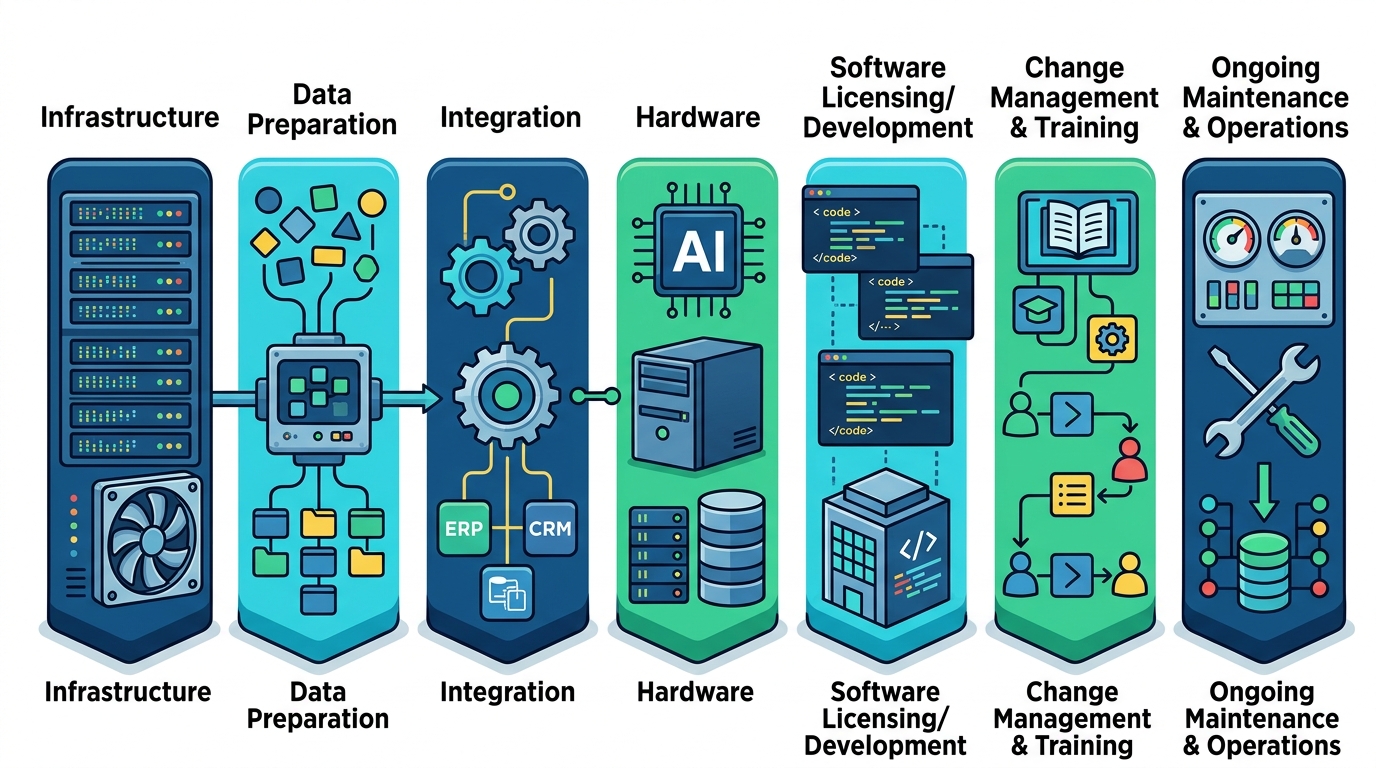
Implementing enterprise AI across an entire organization involves more than just purchasing software licenses. The total cost of ownership includes infrastructure, data preparation, integration, and ongoing management. Understanding these expenses helps leaders budget realistically and avoid unexpected overruns. This guide outlines the seven primary cost categories to consider when deploying AI at scale. For additional details, review the How getting started works.
1. Infrastructure and Compute Costs
Compute resources are the foundational expense for running AI models. Whether you deploy on-premise or in the cloud, you must pay for the processing power required to train and run models. For large language models, this can mean significant GPU or TPU costs. Organizations must also account for storage and network bandwidth as data volumes grow. For additional details, review the Questions Sabina.
2. Data Engineering and Preparation
Clean, structured data is the most expensive input in any AI project. Data engineering is the process of collecting, cleaning, and organizing raw data into a usable format. Most organizations spend heavily on data pipelines to ensure accuracy and consistency. Without this foundation, AI models produce unreliable results, leading to wasted compute and development time. For additional details, review the Tour the Back Office.
3. Model Development and Fine-Tuning
Customizing models for specific business tasks requires specialized expertise. Model development is the process of training or fine-tuning AI to perform specific functions. This often involves hiring data scientists or ML engineers, which commands high salaries. You may also need to purchase or license pre-trained models, adding to the initial outlay. For additional details, review the Trust Company Data and.
4. Integration and API Fees
Connecting AI to existing systems drives up engineering hours. Integration is the process of linking AI tools with your current software stack, such as CRMs or ERPs. API fees can accumulate quickly if your AI solution makes frequent calls to external services. Legacy systems often require custom middleware, increasing development complexity and cost.
5. Security and Compliance
Protecting sensitive data requires robust security measures. Security and compliance is the practice of ensuring AI systems meet regulatory standards and protect privacy. This includes implementing access controls, encryption, and audit logs. Industries like finance and healthcare face strict regulations, making compliance a major budget line item.
6. Change Management and Training
7. Ongoing Maintenance and Monitoring
AI models degrade over time and require continuous oversight. Maintenance is the ongoing process of monitoring model performance and updating data. This includes retraining models as data distributions shift and fixing bugs. Many organizations underestimate this recurring cost, treating AI as a one-time purchase rather than a living system.
Choosing the Right Approach
When evaluating these expenses, consider whether a managed service might reduce your total cost of ownership. Managed AI services often bundle infrastructure, maintenance, and security into a predictable monthly fee. This can be more cost-effective for small and midsize businesses that lack dedicated data teams. To explore how a managed approach might fit your organization, visit the Sabina overview.
Frequently Asked Questions
What is the most expensive part of enterprise AI implementation?
Data engineering and preparation is typically the most expensive component. It requires significant time and expertise to clean and structure data, often accounting for 40-60% of the total project cost.
How does a managed AI service reduce costs?
Managed services bundle infrastructure, maintenance, and security into a single subscription. This eliminates the need for large in-house teams and reduces the complexity of managing multiple vendors.
Do I need to buy hardware for enterprise AI?
Not necessarily. Cloud-based AI services allow you to rent compute resources on demand. This shifts capital expenditure to operational expenditure, improving cash flow for many organizations.
What is model drift and why does it cost money?
Model drift is the gradual decline in model accuracy as data changes over time. It costs money because it requires ongoing monitoring and retraining to maintain performance, adding to maintenance budgets.
How long does it take to see ROI from enterprise AI?
ROI timelines vary, but most organizations see initial returns within 6 to 18 months. The speed depends on the complexity of the use case and the quality of the underlying data.